
Artificial Turf vs Natural Grass in Portland: Pros, Cons, and Costs
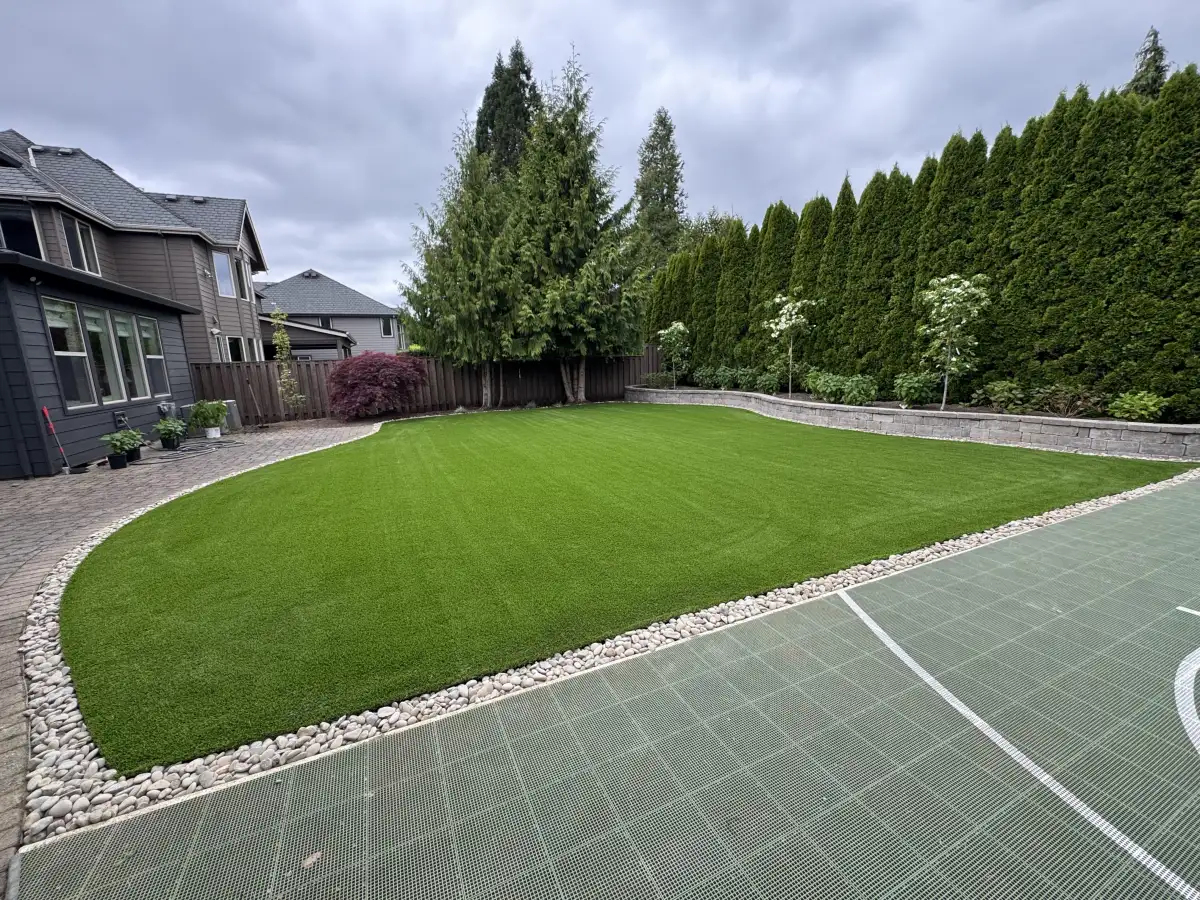
For Portland-area homeowners, artificial turf costs more upfront but saves $200 to $400 per year in maintenance and eliminates the muddy, bare-patch problem that plagues natural lawns from October through April. Natural grass costs less to install and provides environmental benefits like carbon absorption and soil cooling, but it requires ongoing mowing, watering, fertilization, and aeration to stay healthy in Oregon's wet-winter, dry-summer climate.
Neither option is universally better. The right choice depends on how you use your yard, your tolerance for maintenance, and your budget timeline. Below is a detailed, Oregon-specific comparison to help you decide.
Installation Cost Comparison
The initial price gap between artificial turf and natural grass is significant:
| Cost Factor | Artificial Turf | Natural Grass (Sod) |
|---|---|---|
| Materials | $4 - $8 / sq ft | $0.50 - $1.00 / sq ft |
| Installation Labor | $4 - $7 / sq ft | $1.00 - $2.00 / sq ft |
| Total Installed | $8 - $15 / sq ft | $1.50 - $3.00 / sq ft |
| 500 sq ft project | $4,000 - $7,500 | $750 - $1,500 |
| 1,000 sq ft project | $8,000 - $15,000 | $1,500 - $3,000 |
Artificial turf costs roughly 4 to 5 times more to install than natural sod. However, the cost comparison changes dramatically when you factor in ongoing maintenance over the product's lifespan.
Ongoing Maintenance Costs
This is where artificial turf gains ground. A natural lawn in the Portland area requires consistent, year-round investment:
Natural grass annual maintenance costs (500 sq ft lawn):
- Mowing (weekly, March through November): $800 to $1,500/year (professional) or 40+ hours/year (DIY)
- Watering (July through September): $50 to $150/year
- Fertilization (3 to 4 applications): $100 to $250/year
- Aeration and overseeding (annual): $75 to $200
- Weed and moss treatment: $50 to $150/year
- Total: $1,075 to $2,250/year
Artificial turf annual maintenance costs (500 sq ft):
- Occasional rinsing and brushing: $0 (DIY) to $100/year (professional)
- Infill top-up (every 3 to 5 years): $50 to $100 averaged per year
- Total: $50 to $200/year
Over a 15-year period (the typical lifespan of quality artificial turf), here is the total cost comparison for a 500-square-foot area:
| Expense | Artificial Turf | Natural Grass |
|---|---|---|
| Installation | $5,750 (avg) | $1,125 (avg) |
| 15-Year Maintenance | $1,875 | $24,937 |
| 15-Year Total | $7,625 | $26,062 |
When you include professional lawn care costs, artificial turf can save $10,000 to $18,000 over its lifespan. Even DIY-maintained natural lawns require a significant time investment — roughly 40 to 60 hours per year of mowing, edging, and seasonal maintenance.
The Oregon Rain Factor
Portland receives approximately 43 inches of rain annually, with most falling between October and May. This creates two distinct problems for natural grass:
Problem 1: Mud and bare patches. Heavy foot traffic on waterlogged grass destroys the turf crown and creates compacted, bare soil. Families with children and dogs know this well — by December, the backyard becomes a mud pit that does not fully recover until late spring.
Problem 2: Moss invasion. Oregon's overcast, damp conditions are ideal for moss. Left untreated, moss overtakes grass within a single season in shaded areas. Treating moss (typically with iron-based products or lime applications) is an ongoing battle in the Willamette Valley.
Artificial turf eliminates both problems entirely. Quality turf products drain at a rate of 30+ inches per hour — far exceeding Oregon's heaviest rainfall events (typically 0.5 to 1.0 inches per hour). The surface stays firm, dry to the touch within minutes, and completely mud-free year-round.
This is the single biggest reason homeowners in Wilsonville, West Linn, Sherwood, and Tigard switch to artificial turf — not the aesthetics or the cost savings, but the elimination of Oregon's 6-month mud season.
Appearance and Feel
Modern artificial turf has improved dramatically over the last decade. Premium products feature multi-tonal blades (green with brown thatch), varying blade heights, and natural-looking textures that are difficult to distinguish from real grass at a distance.
However, there are differences:
- Texture underfoot: Artificial turf feels slightly different from natural grass — more uniform and slightly springy. Most homeowners adapt within a few weeks. Infill material (silica sand) helps replicate the feel of soil beneath the blades.
- Temperature: On hot, sunny days (July and August in Oregon), artificial turf surfaces can reach 120 to 150 degrees Fahrenheit — significantly hotter than natural grass. This is a real concern for bare feet and pets during Portland's summer months. Solutions include shade trees, afternoon watering (cools the surface instantly), and lighter-colored turf products that reflect more heat.
- Aging: Natural grass renews itself continually. Artificial turf gradually fades and flattens over its 15- to 20-year lifespan. By year 12 to 15, most turf looks noticeably worn and may need replacement.
- Seasonal color: Natural grass goes dormant in dry summers (browning) and greens up in fall rain. Artificial turf stays the same shade year-round — which looks excellent in winter when surrounding natural lawns are brown or mossy, but can appear unnaturally green during summer's golden-brown landscape.
Environmental Considerations
Both options have environmental trade-offs that are worth considering honestly.
Natural grass advantages:
- Absorbs carbon dioxide and produces oxygen (a 2,500-square-foot lawn produces enough oxygen for a family of four)
- Cools the surrounding air through evapotranspiration — a natural lawn is 20 to 30 degrees cooler than asphalt or artificial surfaces
- Filters rainwater naturally, removing pollutants as water percolates through soil
- Provides habitat for insects and microorganisms
Artificial turf advantages:
- Eliminates water usage for irrigation (Oregon summers require watering, even with our reputation for rain). A typical lawn uses 25,000 to 35,000 gallons per year in the Portland area.
- No fertilizers or pesticides entering waterways — a significant issue in the Willamette River watershed
- No gasoline-powered mower emissions (the EPA estimates a gas mower produces 11 times more pollution per hour than a new car)
- Many modern turf products are recyclable at end of life, and manufacturers increasingly use recycled content in production
Neither option is clearly "greener" than the other. The environmental calculation depends on your specific water usage, maintenance practices, and how you value carbon sequestration versus chemical runoff reduction.
Best Use Cases for Each Option
Choose Artificial Turf If:
- You have children or dogs that use the backyard heavily during Oregon's rainy season
- Your yard gets significant shade (moss-prone areas where natural grass struggles)
- You want a low-maintenance yard and are willing to invest more upfront
- You are building a dedicated play area, putting green, or pet zone
- You are tired of the annual mud-season cycle
Choose Natural Grass If:
- You have a large yard (1,000+ square feet) where artificial turf costs become prohibitive
- Your yard gets full sun with good drainage — the conditions where natural grass thrives
- You enjoy yard work and gardening as a hobby
- Environmental factors (carbon absorption, soil health) are a priority
- Budget is tight — sod installation costs a fraction of turf
Consider a Hybrid Approach
Many CreekView clients choose both. Artificial turf for the high-traffic play area and dog run, natural landscaping and planting beds around the perimeter. This gives you the mud-free functionality where you need it while maintaining natural elements for aesthetics and environmental benefit.
Professional Turf Installation in the Portland Metro
Proper turf installation requires more than rolling out grass on dirt. At CreekView Landscape, our installation process includes:
- Excavation: Removing 3 to 4 inches of existing soil and organic material
- Grading: Ensuring proper drainage slope (minimum 1 percent grade away from structures)
- Base preparation: Installing 3 to 4 inches of compacted Class II road base or decomposed granite
- Weed barrier: Commercial-grade landscape fabric beneath the turf
- Turf installation: Precision cutting, seaming, and securing with galvanized nails every 6 inches along edges
- Infill application: Brushing in 2 to 3 pounds of silica sand per square foot for weight, stability, and blade support
- Final grooming: Power brushing to stand blades upright for a natural appearance
Skipping steps — especially base preparation and proper drainage grading — leads to puddles, wrinkles, and premature deterioration. In Oregon's wet climate, drainage is the single most critical factor in a turf installation that performs well long-term.
Get Your Free Turf or Lawn Estimate
Whether you are leaning toward artificial turf, natural sod, or a hybrid approach, CreekView Landscape can help you evaluate your options. We serve Wilsonville, West Linn, Lake Oswego, Sherwood, Tigard, Beaverton, Tualatin, and Happy Valley with free on-site consultations.
We will assess your yard's sun exposure, drainage, traffic patterns, and soil conditions to recommend the best approach for your property and budget.
Or call us directly at (971) 983-6455.
About CreekView Landscape
CreekView Landscape LLC is a locally owned landscaping and hardscaping company based in Woodburn, Oregon. Founded in 2024, the team installs artificial turf, natural sod, paver patios, retaining walls, and complete backyard remodels serving homeowners across Portland's south suburbs.