
Best Pavers for Oregon Weather: A Homeowner's Guide
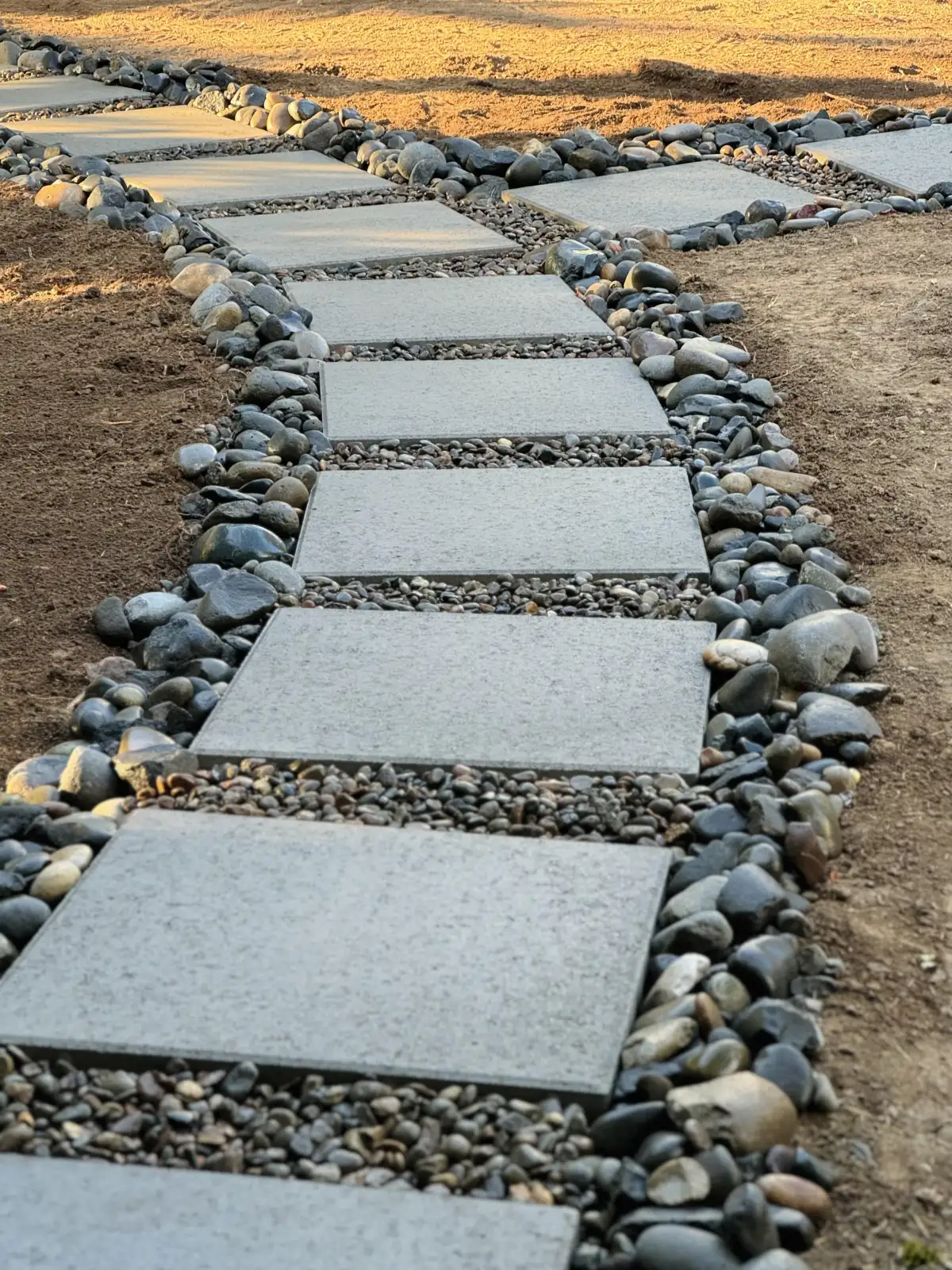
The best pavers for Oregon weather are interlocking concrete pavers with a minimum compressive strength of 8,000 PSI and a water absorption rate below 5 percent. They handle the Willamette Valley's freeze-thaw cycles, resist moss and algae growth better than porous materials, and cost less than natural stone — making them the top choice for patios, walkways, and driveways across the Portland metro area.
That said, every paver material has trade-offs. Below is a detailed comparison of the four most common paver types used in Oregon, with specific guidance on how each performs in our climate.
Oregon's Climate Challenges for Pavers
Before comparing materials, it helps to understand what Oregon weather throws at outdoor hardscaping. The Portland metro area — including Wilsonville, West Linn, Lake Oswego, Sherwood, and Tigard — deals with three primary challenges:
- Heavy rain: Portland averages 43 inches of rainfall per year, with 150+ measurable rain days. Pavers must drain well, and the base beneath them must handle significant water flow without shifting.
- Freeze-thaw cycles: While Oregon's winters are milder than the Midwest, the Willamette Valley still experiences 20 to 30 freeze-thaw cycles per year. Water seeps into paver surfaces and joints, freezes, expands, then thaws — repeating throughout winter. Pavers with high water absorption crack and spall within a few years.
- Moss and algae: Oregon's damp, shaded conditions are ideal for biological growth. Rough or porous surfaces trap moisture and organic material, accelerating moss colonization. Smooth, dense surfaces resist it.
Concrete Pavers: Best Overall for Oregon
Concrete pavers are manufactured under extreme compression (typically 3,000+ PSI hydraulic pressure), producing a dense, uniform product with consistent performance characteristics.
Why they work in Oregon:
- Compressive strength of 8,000+ PSI (industry standard per ASTM C936) — far exceeds what freeze-thaw cycles can damage
- Water absorption rates of 3 to 5 percent — low enough to resist freeze-thaw cracking
- Smooth to semi-textured surfaces that discourage moss attachment
- Interlocking designs transfer load across multiple pavers, preventing individual settlement
- Wide range of colors, textures, and patterns — modern concrete pavers convincingly replicate natural stone at roughly half the price
Cost: $3 to $8 per square foot for materials, or $15 to $25 per square foot installed.
Lifespan: 25 to 50 years with proper base preparation and joint sand maintenance.
Maintenance: Annual power washing and re-sanding joints every 3 to 5 years. Polymeric sand (recommended for Oregon) hardens between joints, preventing weed growth and reducing ant infiltration.
At CreekView Landscape, concrete pavers account for the majority of our paver installation projects. We install a 6- to 8-inch compacted gravel base to account for Oregon's clay soils, which is critical for long-term stability.
Natural Stone Pavers: Premium Look, Higher Cost
Natural stone — including flagstone, bluestone, travertine, and granite — offers unmatched visual appeal. Each piece is unique, and the material ages gracefully over decades.
Oregon-specific considerations:
- Flagstone and bluestone perform well in Oregon's freeze-thaw cycles due to their dense composition and low porosity
- Travertine is naturally porous (absorption rates of 5 to 10 percent) and is not recommended for Oregon patios — it absorbs moisture and is prone to spalling in freeze-thaw conditions
- Granite is nearly indestructible but significantly more expensive and harder to cut on-site
- Natural stone surfaces tend to be rougher, making moss removal more labor-intensive — plan for bi-annual cleaning
- Irregular shapes (flagstone) require mortar joints or wider spacing, which can trap debris and promote weed growth
Cost: $8 to $25 per square foot for materials, or $25 to $50+ per square foot installed.
Lifespan: 50 to 100+ years (material itself lasts indefinitely; base and jointing may need attention sooner).
Best for: Homeowners with larger budgets who want a one-of-a-kind look and are willing to invest in regular cleaning. Flagstone and bluestone are the best natural stone choices for Oregon's climate.
Permeable Pavers: Best for Drainage-Sensitive Properties
Permeable pavers (also called pervious pavers) are designed with wider joints or porous surfaces that allow rainwater to filter through into a gravel reservoir beneath, reducing stormwater runoff.
Why they matter in Oregon:
- Oregon's stormwater regulations are increasingly strict, particularly in Washington County and Clackamas County. Permeable pavers can help meet or exceed local infiltration requirements.
- Properties with poor drainage, high water tables, or proximity to streams benefit significantly from permeable paving
- Eliminates standing water on the surface — a common problem with standard pavers during heavy Oregon rain events
- The open-graded aggregate base acts as a subsurface detention system, slowly releasing water rather than overwhelming storm drains
Oregon-specific caveats:
- The open joint system collects organic debris faster in Oregon's leaf-heavy fall season — requires more frequent maintenance (vacuuming or blowing out joints annually)
- Wider joints provide more surface area for moss and weed establishment
- Not ideal for steep slopes — water infiltration on a grade can cause subsurface erosion
- Base construction costs more (requires clean, open-graded aggregate instead of standard road base)
Cost: $6 to $15 per square foot for materials, or $20 to $35 per square foot installed (higher base costs offset somewhat lower material costs).
Lifespan: 25 to 40 years with regular joint maintenance.
Best for: Driveways, parking areas, and patios on properties with known drainage issues or stormwater compliance requirements.
Brick Pavers: Classic Look, Mixed Oregon Performance
Clay brick pavers have a traditional, warm aesthetic that appeals to homeowners with craftsman-style or colonial homes — common across the Portland metro area.
Oregon-specific considerations:
- Brick quality varies enormously. High-fired brick (rated "SX" for severe weathering per ASTM C902) handles freeze-thaw well. Lower-grade brick ("MX" moderate weathering) will spall and flake within a few Oregon winters.
- Brick is more porous than concrete pavers (typical absorption rate 6 to 10 percent), making it more susceptible to moss and algae colonization
- Color fading is less of a concern than with concrete — clay brick maintains its color through the body of the material
- Brick is softer than concrete pavers (compressive strength typically 5,000 to 8,000 PSI), making it slightly more prone to chipping under heavy loads
Cost: $5 to $12 per square foot for materials, or $18 to $30 per square foot installed.
Lifespan: 25 to 100 years depending on brick grade and exposure.
Best for: Walkways, garden paths, and lower-traffic patios where the aesthetic matches the home style. Always specify SX-rated brick for Oregon installations.
Paver Comparison Table for Oregon
| Factor | Concrete | Natural Stone | Permeable | Brick |
|---|---|---|---|---|
| Freeze-Thaw Resistance | Excellent | Good to Excellent | Good | Good (SX grade) |
| Moss Resistance | Good | Fair | Fair | Fair |
| Drainage | Standard | Standard | Excellent | Standard |
| Cost (Installed) | $15 - $25/sqft | $25 - $50/sqft | $20 - $35/sqft | $18 - $30/sqft |
| Lifespan | 25 - 50 years | 50 - 100+ years | 25 - 40 years | 25 - 100 years |
| Maintenance Level | Low | Medium | Medium-High | Medium |
| Oregon Recommendation | Top Pick | Premium Choice | Drainage Focus | Aesthetic Match |
Base Preparation: The Real Key to Paver Longevity in Oregon
Regardless of which paver material you choose, the base beneath the pavers determines how long they last. Oregon's clay-heavy soils hold water and expand when wet, then shrink when dry. Without a proper base, pavers settle, shift, and develop uneven surfaces within a few years.
A proper Oregon paver base includes:
- Excavation: Remove 8 to 12 inches of native soil
- Geotextile fabric: Prevents clay from migrating up into the gravel base
- Compacted aggregate base: 6 to 8 inches of 3/4-inch crushed gravel, compacted in 2-inch lifts
- Bedding layer: 1 inch of coarse sand or fine chip, screeded level
- Edge restraint: Aluminum or concrete edge restraint anchored with spikes to prevent lateral movement
Cutting corners on the base — using only 4 inches of gravel, skipping geotextile, or not compacting properly — is the most common reason paver patios fail prematurely in Oregon.
Get Expert Paver Installation in the Portland Metro
CreekView Landscape installs paver patios, walkways, and driveways across Wilsonville, West Linn, Lake Oswego, Sherwood, Tigard, Beaverton, Tualatin, and Happy Valley. We build every project on a properly engineered base designed for Oregon's specific soil and weather conditions.
Ready to see which pavers are right for your property? We provide free on-site estimates with material samples so you can compare options in your own backyard.
Or call us at (971) 983-6455.
About CreekView Landscape
CreekView Landscape LLC is a locally owned landscaping and hardscaping company based in Woodburn, Oregon. Founded in 2024, the team specializes in paver patios, retaining walls, turf installation, and complete backyard remodels serving homeowners across Portland's south suburbs.